Attic ventilation: the reason Mobile roofs die young
A Mobile attic in August runs 130 to 150 degrees and holds more moisture than almost any attic in the country. Without a real path for air in at the soffits and out at the ridge, the shingles cook from below, the deck sweats, the nails rust and the roof lasts 15 years instead of 25.
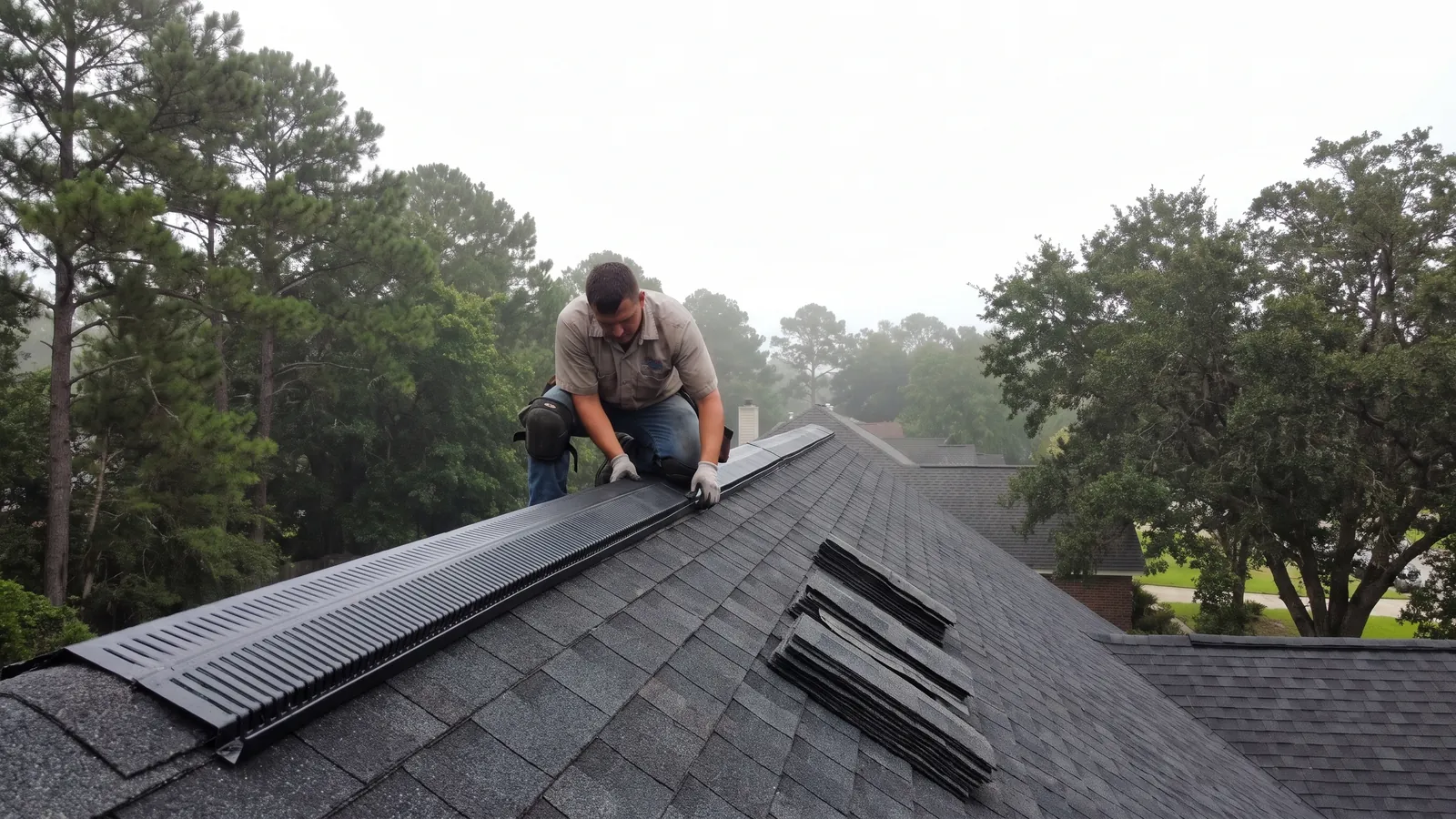
Open an attic hatch in Spring Hill or Tillmans Corner on an August afternoon and you'll feel it: 140 degrees, air so thick it's wet. That heat radiates down through the ceiling and runs your air conditioner, and it bakes the asphalt in the shingles above it; the shingle warranties that promise 30 years assume a vented attic, and a cooked shingle curls, cracks and sheds granules in half that. The moisture is the other half. Warm humid air that gets into the attic from the house, or just from outside, condenses on the underside of the deck on cool nights and on duct work all day: rusted nail tips, black-stained OSB, mold on the north rafters and insulation that's lost its loft. On inspections we see it constantly, and the owners usually think the roof is leaking. It isn't; it's sweating.
The fix is a balanced system, which most Mobile houses don't have: continuous intake at the soffits (not the painted-over or stuffed-with-insulation vents that pass for soffit venting on a lot of 1990s houses), baffles at every rafter bay so the insulation doesn't block the air path, and exhaust at the ridge through a continuous ridge vent, sized to the attic by the 1-to-150 or 1-to-300 rule depending on the vapor retarder. Power fans and turbines are usually the wrong answer here; a powered fan with weak intake pulls conditioned air out of the house through every ceiling gap, and turbines are the first thing to leave in a hurricane. On a FORTIFIED roof the vents also have to pass the IBHS wind-driven-rain test, so we use wind-rated ridge and off-ridge vents and seal the old turbine holes.
The best time to fix ventilation is with the roof, when the ridge is open and the soffits are accessible, and it's part of every replacement we do. But it can be done on an existing roof too: a ridge vent cut in, soffit vents opened or added, baffles installed from inside, and the turbines and gable fans that fight the system removed. The result is a cooler house, lower power bills, a drier attic, and a roof that reaches the far end of its life instead of the near end.
What's included
Soffit intake, actually open
Continuous or individual soffit vents cleared of paint and insulation, or added where the builder skipped them.
Baffles in every rafter bay
Air chutes so the insulation can't block the path from soffit to ridge.
Continuous ridge vent
Cut in and installed at the peak, sized to the attic, with wind-rated vents on FORTIFIED roofs.
Turbines and gable fans removed
The fixtures that leave in a hurricane and short-circuit the system taken out and the holes sealed.
Moisture diagnosis
Rusted nails, stained decking, mold and wet insulation traced to the source: ventilation, bath fans vented into the attic, or duct leaks.
Bath and dryer vents routed outside
Fans dumping into the attic rerouted through the roof or wall with proper caps.
Attic ventilation cost in Mobile, AL
| Job | Typical price | Notes |
|---|---|---|
| Continuous ridge vent, cut in on an existing roof | $600 – $1,400 | Typical home |
| Soffit vents added or opened | $300 – $1,200 | By the number of bays |
| Baffles installed from inside | $250 – $800 | Per attic |
| Turbine or gable fan removed and sealed | $150 – $350 each | Shingled over |
| Bath fan vented through the roof | $250 – $500 each | With a wind-rated cap |
| Ventilation included with a replacement | Included | Ridge vent, baffles, soffit check |
These are 2026 Mobile-area ranges so you can budget. Your written price is itemized (tear-off, decking, underlayment, sealed deck, flashing, vents, disposal, permit) and good for 30 days.
Recent work
Questions we get about attic ventilation
How do I know my attic is under-vented?
Rusty nail tips, dark stains on the decking, mold on the rafters, insulation that's matted down, a second-floor that won't cool, and shingles that curled before their time. Put a thermometer in the attic on a summer afternoon: over 130 degrees with the sun off the roof is a sign.
Is a power attic fan a good idea in Mobile?
Usually not. With weak soffit intake it pulls air-conditioned air out of the house and can pull combustion gases back down a water heater flue. Passive ridge-and-soffit venting, done right, moves plenty of air in this climate.
What about the whirlybird turbines?
They work when they spin and they leave in a hurricane, taking a hole in the roof with them. On every replacement we remove them and go to a ridge vent, which FORTIFIED requires anyway.
Can you fix ventilation without replacing the roof?
Yes. Ridge vent cut in, soffits opened, baffles added and turbines sealed on an existing roof in a day.
Will better ventilation lower my power bill?
A cooler attic means less heat through the ceiling and less work for the ducts running through it. The savings vary by house, but a 140-degree attic brought down 20 or 30 degrees is noticeable in July.
My bathroom fan blows into the attic. Is that a problem?
A big one in this humidity. It's a constant source of moisture that condenses on the deck. We route it through the roof with a proper cap.